
Rugs Vs Carpet at a Glance — Compare Live Prices
Our top picks compared side by side, with prices pulled live from Amazon:
Prices & availability accurate as of October 5, 2026 and may change. As an Amazon Associate, Inside Decors earns from qualifying purchases.
By Inside Decors · Updated January 15, 2026
Affiliate Disclosure: This article contains affiliate links. If you make a purchase through these links, we may earn a small commission at no extra cost to you.
When it comes to setting the tone for your home, never underestimate the impact of what lies beneath your feet. Whether it’s a plush carpet that invites you to kick off your shoes and relax, or a vibrant area rug adding a splash of color to your hardwood floor, these elements can dramatically transform a room.
As an interior designer with over a decade of experience helping homeowners make flooring decisions, I’ve seen firsthand how the carpet versus rug choice affects not just aesthetics, but daily living, maintenance routines, and long-term budgets. This isn’t a simple either-or decision—it’s about understanding your lifestyle, your space, and your design goals.
In this comprehensive guide, I’ll walk you through everything you need to know about rugs vs carpets, from installation costs and maintenance realities to design flexibility and resale value. You’ll get specific price ranges, real-world trade-offs, and practical advice based on actual client projects and industry experience.
Short on time? Jump straight to our editor-vetted picks and compare current prices.
Key Takeaways
- Carpets are wall-to-wall installations that provide uniform coverage, superior insulation, and noise reduction—ideal for bedrooms, stairs, and homes in cold climates (expect $3-$12 per square foot installed)
- Rugs are portable, versatile floor coverings that protect existing floors, allow easy style changes, and simplify cleaning—perfect for renters, design enthusiasts, and high-traffic areas (ranging from $50 to $5,000+ depending on size and quality)
- Installation matters: Carpet requires professional installation ($1-$2 per square foot labor), while rugs need only a quality rug pad ($20-$100)
- Maintenance differs significantly: Carpets need annual deep cleaning ($100-$300 per room), while most rugs can be spot-cleaned or professionally cleaned as needed ($75-$200)
- The best choice depends on: room function, existing flooring, budget, lifestyle (pets, kids, allergies), and how often you like to refresh your décor
Carpet vs Rug: Understanding the Fundamentals

Before we explore the pros and cons of each, let’s establish clear definitions—because in interior design, precision matters.
A carpet is a textile floor covering that extends wall-to-wall and is permanently installed to the floor using tack strips, adhesive, or padding. Carpets are manufactured in large rolls (typically 12 or 15 feet wide) and cut to fit your specific room dimensions. They provide complete floor coverage and become a semi-permanent fixture in your home, similar to choosing the right bathroom fittings that you’ll live with for years.
A rug (also called an area rug) is a smaller, free-standing textile floor covering that sits atop your existing flooring. Rugs come in standard sizes—from small accent rugs (2’x3′) to large room-sized pieces (9’x12′ or larger)—and can be easily moved, replaced, or removed. They’re designed to define spaces, add warmth, and serve as decorative elements within a room.
The Core Differences
Size and Coverage: Carpets cover entire floor surfaces from wall to wall, while rugs cover specific areas and leave portions of the underlying floor visible. In a 12’x15′ bedroom, carpet would cover all 180 square feet, whereas a typical 8’x10′ rug would cover only about 44% of the floor space.
Installation and Permanence: Carpet installation requires professional tools, subfloor preparation, padding, and specialized cutting. Removal involves tearing out the carpet, padding, and tack strips—a messy, labor-intensive process. Rugs simply require a quality rug pad and can be repositioned in minutes.
Flexibility: This is where rugs shine. I’ve had clients who rotate rugs seasonally—lighter colors and natural fibers in summer, richer tones and plush textures in winter. Try doing that with wall-to-wall carpet.
Cost Structure: Carpet pricing includes materials, padding, installation labor, and eventual removal costs. Rug pricing is typically just the rug itself plus a rug pad, making the upfront investment more transparent and often more affordable for smaller spaces.
Pros and Cons of Carpets: The Complete Picture

Let me share what I’ve learned from dozens of carpet installations—both the triumphs and the regrets.
The Advantages of Wall-to-Wall Carpet
Unmatched Comfort and Warmth
There’s a reason bedrooms and family rooms have traditionally featured carpet. Walking barefoot on quality carpet feels luxurious, and the difference is especially noticeable on cold winter mornings. Carpet provides an R-value (thermal resistance) of approximately 1.0-2.0 depending on thickness and density—not huge, but enough to make rooms feel 2-3 degrees warmer and reduce heating costs by 4-8% in carpeted rooms.
I recently worked with a family in Minnesota who replaced their hardwood bedroom floors with a thick, plush wool carpet. They reported noticeably warmer feet in the morning and reduced noise transfer to the room below—a significant quality-of-life improvement.
Superior Noise Reduction
Carpet absorbs sound rather than reflecting it. In acoustic testing, carpet with quality padding can reduce noise transmission by 25-35 decibels. For families with children, multi-story homes, or anyone sensitive to noise, this is transformative. One client with a home office above the family room installed carpet specifically to dampen the sound of kids playing below—it worked remarkably well.
Extensive Design Options
The variety available in carpet is staggering. You can choose from:
- Textures: Cut pile (plush, saxony, frieze), loop pile (berber, level loop), or cut-and-loop combinations
- Materials: Nylon (most durable, 60-70% of market), polyester (soft, stain-resistant), wool (luxurious, natural), triexta (newer, eco-friendly), olefin (budget-friendly, moisture-resistant)
- Colors and Patterns: From solid neutrals to intricate patterns, custom dyeing options, and even printed designs
- Pile Heights: Low pile (less than ¼ inch) for high-traffic areas, medium pile (¼-½ inch) for balanced comfort, high pile (½ inch+) for luxury
This variety allows carpet to work with virtually any interior design style, from minimalist to traditional.
Long-Term Durability (When Chosen Correctly)
Quality carpet in appropriate locations can last 10-15 years or even longer. I’ve seen commercial-grade nylon carpets in residential hallways still looking good after 20 years. The key is matching the carpet quality to the room’s traffic level:
- Light traffic (bedrooms): Medium-grade polyester or nylon works well
- Moderate traffic (living rooms): Higher-grade nylon or wool
- Heavy traffic (hallways, stairs): Commercial-grade nylon or dense loop pile
Safety Benefits
Carpet provides cushioning that reduces injury risk from falls—particularly important for homes with elderly residents or young children. The soft surface also provides better traction than hard flooring, reducing slip-and-fall accidents.
The Drawbacks of Wall-to-Wall Carpet
Maintenance Demands and Allergen Concerns
Here’s the reality: carpet requires consistent maintenance. Weekly vacuuming is non-negotiable, and annual professional deep cleaning ($100-$300 per room) is essential to maintain appearance and hygiene. Even with diligent care, carpets trap:
- Dust mites and their waste products
- Pet dander and hair
- Pollen brought in from outdoors
- Volatile organic compounds (VOCs) from household products
- Bacteria and mold (especially in humid climates or after spills)
For allergy sufferers, this can be problematic. The Carpet and Rug Institute promotes carpet as an “allergen trap” that removes particles from breathing zones, but this only works if you vacuum with HEPA filtration 2-3 times weekly and deep clean regularly—a commitment many homeowners underestimate.
Stain Vulnerability
Despite advances in stain-resistant treatments, carpet remains vulnerable to permanent staining. Red wine, pet accidents, bleach-containing cleaners, and even some foods can cause irreversible damage. I’ve seen beautiful carpets ruined by a single incident—a spilled candle, a pet accident that wasn’t discovered immediately, or a child’s art project gone wrong.
Installation Costs and Complexity
Professional carpet installation for a 12’x15′ bedroom typically costs:
- Budget carpet: $3-$5 per square foot installed ($540-$900 total)
- Mid-range carpet: $6-$8 per square foot installed ($1,080-$1,440 total)
- Premium carpet: $9-$12+ per square foot installed ($1,620-$2,160+ total)
These prices include padding and installation labor. Stairs add $3-$10 per step. Removal of old carpet adds $1-$2 per square foot.
Limited Flexibility and Replacement Challenges
Once installed, carpet is essentially permanent until you’re ready for a major renovation. You can’t easily change the look of a room, and if one area gets damaged or stained, you typically can’t replace just that section without visible seams and color mismatches.
Removal is messy, time-consuming, and creates substantial waste. I’ve overseen carpet removal projects where the debris filled an entire dumpster—padding, carpet, tack strips, and staples all had to go.
Moisture and Odor Issues
Carpet in moisture-prone areas (basements, bathrooms, kitchens) is generally a poor choice. Once carpet gets wet—from flooding, plumbing leaks, or high humidity—it can develop mold and mildew within 24-48 hours. The padding beneath the carpet is especially problematic, as it’s difficult to dry thoroughly.
Pet odors can also penetrate carpet and padding, sometimes requiring complete replacement rather than just cleaning.
Pros and Cons of Rugs: Real-World Experience

After helping clients select hundreds of rugs, I’ve developed strong opinions about when they’re the perfect solution—and when they’re not.
The Advantages of Area Rugs
Design Flexibility and Easy Updates
This is the rug’s superpower. Want to shift from a boho living room aesthetic to something more refined? Swap the rug. Seasonal decorating enthusiast? Rotate rugs with the seasons. Moving to a new home? Take your rugs with you.
I worked with a client who loved redecorating and changed her living room rug three times in two years—from a traditional Persian to a modern geometric to a natural jute. Each transformation took less than an hour and cost far less than replacing wall-to-wall carpet would have.
Lower Initial Investment
Quality rugs range widely in price, but you can find excellent options at every budget:
- Budget-friendly synthetic rugs: $50-$300 (machine-made polypropylene or polyester)
- Mid-range rugs: $300-$1,500 (better synthetics, wool blends, hand-tufted)
- Premium rugs: $1,500-$5,000+ (hand-knotted wool, silk, or natural fibers)
For a search for quality area rugs on Amazon, you’ll find thousands of options across all price points. Unlike carpet, there’s no installation labor cost—just add a quality rug pad from Amazon ($20-$100 depending on size) to prevent slipping and extend the rug’s life.
Simplified Cleaning and Maintenance
Most rugs can be:
- Vacuumed regularly (weekly for high-traffic areas)
- Spot-cleaned immediately when spills occur
- Taken outside for a good shake or beating to remove embedded dirt
- Professionally cleaned when needed ($75-$200 depending on size and material)
- Replaced if permanently damaged or stained
Smaller rugs (up to about 5’x7′) can sometimes even be cleaned in a bathtub or taken to a laundromat with large washers. This flexibility is invaluable for pet owners and families with young children.
Floor Protection
Rugs protect your existing flooring from:
- Scratches and dents (especially important for hardwood)
- UV fading in sunny areas
- Wear patterns in high-traffic zones
- Furniture leg indentations
- Spills and stains
I’ve seen rugs save hardwood floors from catastrophic damage—a broken fish tank, a knocked-over plant, a leaking radiator. In each case, the rug absorbed the damage, and the floor beneath remained pristine.
Space Definition in Open Floor Plans
In modern open-concept homes, rugs are essential design tools. They visually separate the living area from the dining area, define a reading nook, or anchor a conversation area. This is particularly important in creating a cohesive interior design in large, undefined spaces.
Rental-Friendly
For renters, rugs are often the only option for adding warmth and style to floors. They’re completely non-permanent and move with you—a significant advantage in today’s mobile lifestyle.
The Drawbacks of Area Rugs
Size Limitations and Coverage Gaps
Rugs come in standard sizes, and finding the perfect fit can be challenging. Common sizes include:
- 2’x3′ (accent)
- 3’x5′ (small area)
- 5’x7′ (medium area)
- 8’x10′ (large area)
- 9’x12′ (room-sized)
If your room is 13’x16′, even a 9’x12′ rug will leave significant floor exposed around the edges. Custom-sized rugs are available but expensive—often 50-100% more than standard sizes.
Edge Curling and Tripping Hazards
Rug edges can curl, creating tripping hazards, especially with:
- Lightweight rugs on hard flooring
- Rugs in high-traffic areas
- Rugs without proper padding
- Older rugs with deteriorating backing
A quality rug pad mostly solves this, but it’s an additional expense and consideration. I always recommend non-slip rug pads from Amazon for safety, especially in homes with elderly residents or young children.
Vacuum Challenges
Vacuuming rugs, especially thick or shag varieties, can be more difficult than vacuuming carpet. The rug edges catch on vacuum cleaners, and some vacuum types (especially robotic vacuums) struggle with rug transitions. Fringe edges require special care to avoid damage.
Limited Texture Variety
While rugs offer tremendous variety in color and pattern, the texture options are more limited than carpet. You won’t find the same range of pile heights, densities, and constructions. Most rugs are either flat-weave, hand-tufted, or hand-knotted, with less variation within each category.
Potential for Sliding and Bunching
Without proper padding, rugs can slide on hard flooring—a safety issue and a daily annoyance. Even with padding, rugs in high-traffic areas may gradually shift and require straightening. Rugs on carpet can bunch and wrinkle, creating an unkempt appearance.
Carpet vs Rug: Side-by-Side Comparison
Here’s a practical comparison table to help you evaluate both options:
| Factor | Wall-to-Wall Carpet | Area Rugs |
|---|---|---|
| Initial Cost | $3-$12+ per sq ft installed (12’x15′ room: $540-$2,160+) | $50-$5,000+ depending on size and quality |
| Installation | Professional required ($1-$2/sq ft labor) | DIY-friendly, just add rug pad ($20-$100) |
| Lifespan | 10-15 years (up to 20+ for premium) | 5-20+ years depending on quality and traffic |
| Maintenance | Weekly vacuuming, annual deep cleaning ($100-$300/room) | Weekly vacuuming, spot cleaning, occasional professional cleaning ($75-$200) |
| Design Flexibility | Permanent until replacement | Easily changed, rotated, or removed |
| Allergen Management | Traps allergens (good if cleaned regularly, bad if not) | Easier to clean thoroughly, can be removed/replaced |
| Noise Reduction | Excellent (25-35 decibel reduction) | Moderate (10-20 decibel reduction) |
| Insulation Value | Superior (R-value 1.0-2.0) | Moderate (R-value 0.5-1.0) |
| Stain Risk | High (permanent installation means stains stay) | Moderate (can be professionally cleaned or replaced) |
| Moisture Tolerance | Poor (mold/mildew risk when wet) | Better (can be dried or replaced) |
| Resale Impact | Neutral to positive if new/clean, negative if worn/stained | No impact (not permanent) |
| Best For | Bedrooms, stairs, cold climates, noise reduction, uniform look | Living rooms, dining rooms, renters, design enthusiasts, floor protection |
Top Rugs Vs Carpet Picks — Live Prices
Hand-checked against Amazon right now, best current deals first:


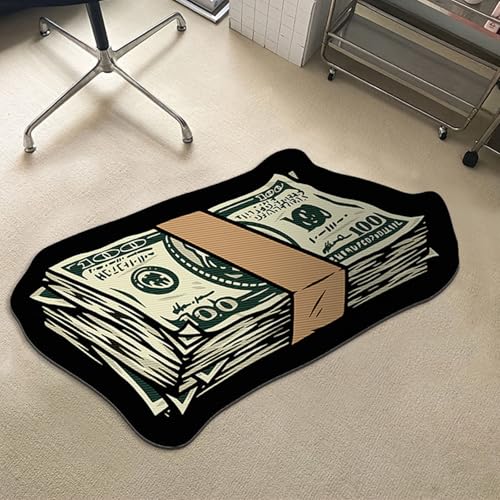
Prices & availability accurate as of October 5, 2026 and may change. As an Amazon Associate, Inside Decors earns from qualifying purchases.
Factors to Consider When Choosing Between Rugs and Carpets
Let me walk you through the decision-making framework I use with clients.
Room Function and Traffic Patterns
Bedrooms: Carpet wins here for most people. The comfort underfoot when getting out of bed, the warmth in winter, and the noise reduction all favor carpet. However, if you have beautiful hardwood floors or severe allergies, a large area rug beside the bed might be better.
Living Rooms: This depends on your existing flooring and lifestyle. If you have hardwood, tile, or laminate, a large area rug can define the seating area while showcasing your floors. If you have concrete subfloor or old flooring you want to hide, carpet provides complete coverage.
Dining Rooms: I typically recommend rugs here—specifically, flat-weave or low-pile rugs that allow chairs to slide easily. Make sure the rug extends at least 24 inches beyond the table on all sides so chairs remain on the rug when pulled out. Dining room rugs on Amazon offer many suitable options.
Hallways and Stairs: Carpet is usually the better choice for safety, noise reduction, and durability. Runners can work in hallways but require careful securing to prevent slipping.
Basements: Avoid carpet in basements prone to moisture. If you want softness, use rugs that can be easily removed if water intrusion occurs.
Existing Flooring Condition
If you have:
- Beautiful hardwood: Showcase it with area rugs
- Damaged hardwood: Either refinish it and use rugs, or cover completely with carpet
- Concrete subfloor: Carpet provides warmth and comfort; rugs alone may not be sufficient
- Tile or stone: Rugs add essential warmth and define spaces
- Old carpet: Replace with new carpet or remove and use rugs on the subfloor (after refinishing if needed)
Lifestyle Considerations
Pets: Both options have challenges. Carpet can trap pet hair and odors; rugs can be scratched and bunched by active pets. If you have pets, choose:
– Stain-resistant, tightly woven carpet in darker colors, OR
– Durable, washable rugs that can be replaced affordably
Children: Young children mean spills, stains, and wear. Rugs offer easier cleaning and replacement, but carpet provides safer, softer play surfaces. Many families compromise with carpet in bedrooms and playrooms, rugs in living areas.
Allergies: If anyone in your household has significant allergies, hard flooring with washable rugs is generally better than wall-to-wall carpet, despite industry claims about carpet trapping allergens.
Entertaining: If you host frequently, consider how your choice affects acoustics. Carpet dampens sound (good for conversation), while hard floors with rugs create livelier acoustics (which some prefer).
Climate and Seasonal Factors
In cold climates, carpet’s insulation value is significant. In warm, humid climates, hard flooring with rugs provides better moisture management and cooling.
Budget Reality Check
Be honest about your total budget, including:
- Initial purchase and installation
- Padding or rug pads
- Maintenance costs over the expected lifespan
- Eventual replacement or removal costs
Sometimes a quality rug is a better investment than cheap carpet, and vice versa.
Design Vision and Flexibility Needs
Ask yourself:
- How often do I like to change my décor? (Often = rugs; Rarely = carpet)
- Do I want a uniform, cohesive look? (Yes = carpet; No = rugs)
- Am I showcasing flooring or covering it? (Showcasing = rugs; Covering = carpet)
- How long will I live here? (Short-term = rugs; Long-term = either)
Tips for Choosing the Perfect Rug or Carpet for Your Home
Based on years of experience, here are my most valuable recommendations.
Matching to Your Interior Design Style
Your flooring should support, not fight, your overall design vision:
For Modern/Minimalist Spaces: Choose solid colors, geometric patterns, or subtle textures. Low-pile carpet in neutral tones or flat-weave rugs work beautifully. Avoid busy patterns that compete with clean lines.
For Traditional Interiors: Rich colors, classic patterns (Persian, Oriental, medallion designs), and plush textures complement traditional furniture. Consider wool carpet or hand-knotted rugs.
For Transitional Styles: Versatile neutrals with subtle pattern or texture bridge traditional and contemporary. Textured carpet or patterned rugs in muted colors work well.
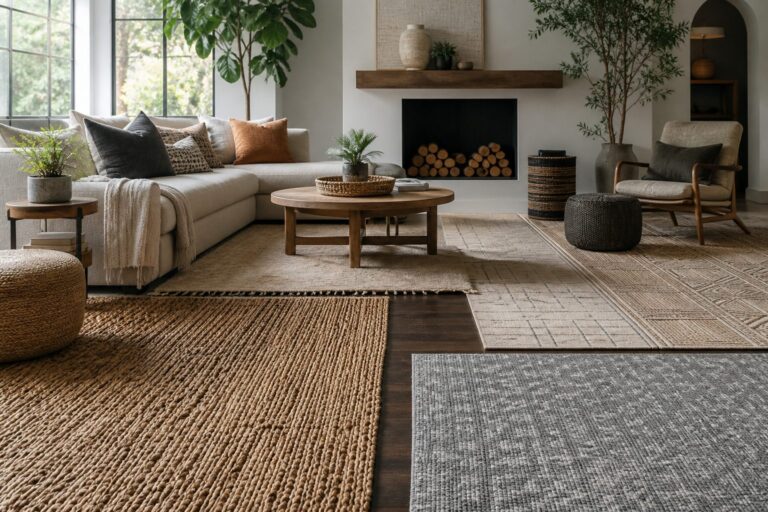
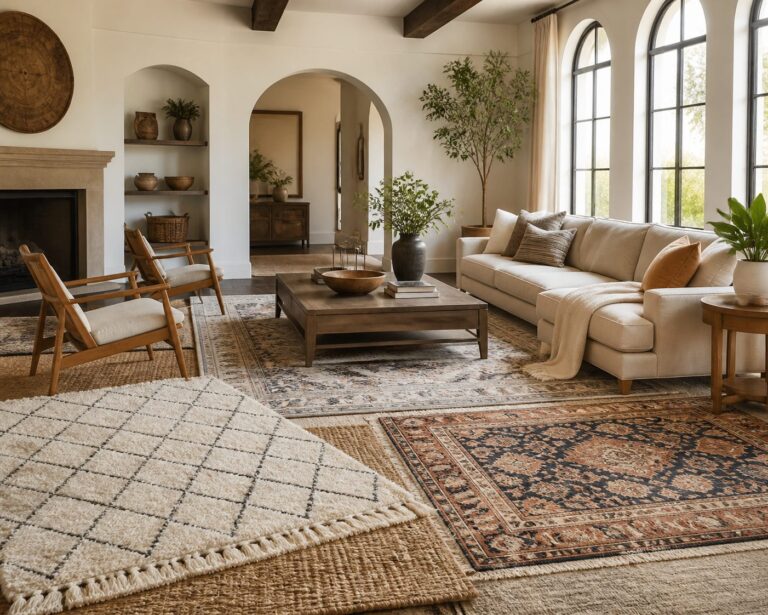
For Boho/Eclectic Spaces: Layered rugs, bold patterns, and natural fibers like jute or sisal create the relaxed, collected vibe. Don’t be afraid to mix patterns and textures.
The 7 principles of interior design apply to flooring choices just as they do to furniture and accessories—balance, proportion, rhythm, emphasis, harmony, contrast, and unity should all inform your decision.
Getting the Size Right
For Rugs in Living Rooms:
– Ideal: All furniture legs on the rug (requires 8’x10′ minimum for most seating arrangements)
– Acceptable: Front legs only on the rug (can work with 5’x7′ or 6’x9′)
– Avoid: Tiny rugs that float in the middle with no furniture touching them
For Rugs in Bedrooms:
– Queen bed: 8’x10′ or 9’x12′ rug extending beyond bed on three sides, OR
– Two runners: 2.5’x8′ or 3’x10′ on each side of the bed, OR
– One runner: 3’x8′ at the foot of the bed
For Rugs in Dining Rooms:
– Measure your table, add 48 inches to length and width (24 inches on each side)
– This ensures chairs remain on the rug when pulled out
– For a 6-foot table, you need at least an 8’x10′ rug
For Carpet:
– Wall-to-wall means exactly that—measure carefully and order 10% extra for waste and pattern matching
Selecting the Right Material
Carpet Materials:
- Nylon: Most durable, resists crushing and matting, excellent for high-traffic areas, moderate price ($3-$8/sq ft)
- Polyester: Soft, stain-resistant, vibrant colors, less durable than nylon, budget to mid-range ($2-$6/sq ft)
- Wool: Luxurious, natural, durable, flame-resistant, expensive ($8-$15+/sq ft)
- Triexta (Smartstrand): Newer fiber, very stain-resistant, eco-friendly, good durability, mid-range ($4-$8/sq ft)
- Olefin/Polypropylene: Budget-friendly, moisture-resistant, good for basements, less resilient ($2-$4/sq ft)
Rug Materials:
- Wool: Durable, soft, naturally stain-resistant, ages beautifully, expensive
- Cotton: Soft, washable, affordable, less durable, works for low-traffic areas
- Jute/Sisal/Seagrass: Natural, textured, eco-friendly, can be scratchy, not for high-moisture areas
- Synthetic (polypropylene, polyester, nylon): Affordable, stain-resistant, easy to clean, less luxurious feel
- Silk: Luxurious sheen, delicate, expensive, decorative rather than functional
- Blends: Combine benefits of multiple fibers (e.g., wool-silk, wool-synthetic)
Understanding Construction Quality
For Carpet:
– Density matters more than pile height: Press your thumb into the carpet—if you easily feel the backing, it’s low density and won’t wear well
– Twist level: Higher twist (5-6 twists per inch) means better resilience and less matting
– Face weight: Measured in ounces per square yard; 40+ oz is good quality, 50+ oz is excellent
For Rugs:
– Hand-knotted: Highest quality, most durable, most expensive, knots per square inch (KPSI) indicates quality (120+ KPSI is good, 300+ is exceptional)
– Hand-tufted: Good quality, moderate price, less durable than hand-knotted
– Machine-made: Most affordable, consistent quality, less character than handmade
– Flat-weave: Durable, reversible, thinner profile, good for high-traffic areas
Maintenance Planning
Before purchasing, understand the care requirements:
For Carpet:
– Vacuum high-traffic areas 2-3 times weekly, other areas weekly
– Address spills immediately with appropriate cleaning solutions
– Professional deep cleaning annually (more often for light colors or high traffic)
– Expect to pay $100-$300 per room for professional cleaning
– Consider carpet protection treatments ($0.25-$0.50 per sq ft)
For Rugs:
– Vacuum weekly (more often for high-traffic areas)
– Rotate rugs every 6-12 months to ensure even wear
– Take outside and shake or beat quarterly to remove embedded dirt
– Professional cleaning every 1-3 years depending on traffic ($75-$200)
– Some rugs (cotton, synthetic) can be spot-cleaned with water and mild detergent
Color and Pattern Strategy
Practical Color Choices:
– Light colors: Show dirt and stains but make rooms feel larger and brighter
– Dark colors: Hide dirt but show dust and pet hair, can make rooms feel smaller
– Medium tones: Best compromise for most households
– Patterns: Hide stains and wear better than solids; choose patterns that complement your furniture
Color Psychology:
– Neutrals (beige, gray, taupe): Versatile, timeless, easy to decorate around
– Blues: Calming, work well in bedrooms and bathrooms
– Greens: Natural, refreshing, good for living spaces
– Warm tones (reds, oranges, yellows): Energizing, cozy, good for social spaces
– Cool tones (blues, greens, purples): Calming, spacious feeling, good for bedrooms
Don’t Forget the Padding
For Carpet:
Quality padding extends carpet life by 50% or more. Spend $0.50-$1.50 per square foot on:
– Density: 6-8 pounds per cubic foot for residential
– Thickness: 7/16 inch to 1/2 inch (not thicker—too much padding causes premature wear)
– Material: Rebond (recycled foam) is most common and affordable; memory foam offers superior comfort; rubber is most durable
For Rugs:
A good rug pad ($20-$100 depending on size) provides:
– Non-slip grip for safety
– Cushioning for comfort
– Air circulation to prevent mold
– Protection for both rug and floor
– Extended rug life by reducing wear
Look for quality rug pads on Amazon that are appropriate for your flooring type (different pads for hardwood vs. tile vs. carpet).
Shop This Look
Editor-picked finds to bring this style home:
- Wool Area Rug →Defines living spaces, adds warmth, and offers sound absorption.
- Wall-to-Wall Carpet →Provides plush comfort, insulates rooms, and unifies open floor plans.
- Layered Jute Rug →Adds texture and visual interest when paired with a smaller rug.
- Patterned Runner Rug →Guides traffic in hallways and adds a decorative touch.
As an Amazon Associate we earn from qualifying purchases.
Frequently Asked Questions
Can you put an area rug over carpet?
Yes, you can place an area rug over carpet, and it’s a common design technique. This works best when you want to define a specific area (like a seating arrangement), add a pop of color or pattern, or protect high-traffic zones on the carpet. Use a thin, non-slip rug pad designed specifically for carpet-to-carpet use to prevent bunching and sliding. Choose a rug with a different texture or pattern than the underlying carpet to create visual interest. This approach is particularly popular in large rooms, rental properties where you can’t replace existing carpet, or when you want to update a room’s look without the expense of new carpet.
How long does carpet typically last compared to rugs?
Quality wall-to-wall carpet typically lasts 10-15 years in residential settings, with premium wool or commercial-grade nylon lasting up to 20 years or more with proper care. Lifespan depends heavily on traffic level, maintenance, and initial quality. Area rugs have a wider range: machine-made synthetic rugs may last 5-10 years, while hand-knotted wool or silk rugs can last 50-100+ years and even appreciate in value. The key difference is that rugs can be rotated to distribute wear, professionally restored, and moved to lower-traffic areas as they age—options not available with installed carpet. For high-traffic areas, expect carpet to show wear in 7-10 years, while a quality rug in the same location might last 15-20 years if properly maintained and rotated.
Which is better for allergies: carpet or rugs?
For allergy sufferers, hard flooring with washable area rugs is generally the better choice, despite carpet industry claims that carpet “traps” allergens and removes them from breathing zones. While carpet does trap allergens, it also provides a reservoir where dust mites, pet dander, pollen, and mold can accumulate. Even with HEPA vacuuming 2-3 times weekly and annual professional cleaning, carpet harbors more allergens than hard flooring. Rugs offer a middle ground—they provide warmth and comfort while being easier to clean thoroughly, and they can be removed entirely for deep cleaning or replacement. If you must have carpet, choose low-pile synthetic varieties, use HEPA filtration vacuums, and invest in professional hot-water extraction cleaning at least twice yearly. For severe allergies, hard flooring with minimal, washable rugs is the gold standard.
What’s the most cost-effective option for a whole house?
For whole-house flooring, the most cost-effective approach depends on your priorities and timeline. Initial installation cost favors carpet in bedrooms and rugs over existing hard flooring in living areas—you might spend $3,000-$6,000 to carpet three bedrooms versus $8,000-$15,000 to install hardwood and add quality rugs. However, over a 20-year period, the math shifts: carpet will need replacement once or twice ($6,000-$12,000 total), while hardwood with rugs might only require rug replacement ($2,000-$4,000) and occasional floor refinishing ($2,000-$3,000). The true “most cost-effective” solution is a hybrid approach: install carpet in bedrooms and on stairs where comfort and safety matter most, use durable hard flooring in main living areas and hallways, and add area rugs for warmth and style. This combination typically costs $8,000-$12,000 initially and $3,000-$5,000 in maintenance over 20 years—the best balance of comfort, durability, and long-term value.
How do I choose between carpet and rugs for a rental property?
For rental properties, area rugs over hard flooring are almost always the better choice. Here’s why: rugs are non-permanent (important when you don’t own the property), easily cleaned or replaced between tenants, and allow you to personalize your space without violating lease terms. Most leases prohibit permanent flooring changes, making carpet installation impossible anyway. If your rental has existing carpet, you can layer area rugs to protect high-traffic zones and add your personal style. When you move, rugs come with you—a significant advantage given that the average renter moves every 2-3 years. The only exception might be if you’re renting a property you own to tenants—in that case, durable, stain-resistant carpet in neutral colors might be better for bedrooms, as it’s harder for tenants to damage than hardwood floors. But for renters themselves, rugs offer flexibility, protection, and personalization without permanent commitment.
Can carpet or rugs increase home resale value?
New, clean, neutral carpet in bedrooms can maintain or slightly increase home value, while worn, stained, or outdated carpet significantly decreases value—often requiring replacement before listing. Real estate professionals consistently report that buyers view old carpet negatively, sometimes reducing offers by $2,000-$5,000 to account for replacement costs. Beautiful hardwood, tile, or luxury vinyl flooring with tasteful area rugs typically adds more value than carpet, as buyers perceive hard flooring as more desirable, modern, and low-maintenance. If you’re preparing to sell, the best strategy is: remove worn carpet and refinish hardwood underneath (if present), install neutral luxury vinyl plank if no hardwood exists, or replace old carpet with builder-grade neutral carpet in bedrooms only. Remove personal area rugs before showings so buyers can see the flooring quality. The exception is high-end homes where premium wool carpet or antique rugs might be selling points—but even then, neutral, pristine condition is essential.
Making Your Final Decision: Carpet, Rug, or Both?
After exploring every angle of the rugs versus carpet debate, you might be wondering: which should I choose?
The truth is, most well-designed homes use both—strategically placed to maximize the benefits of each.
Consider carpet for:
– Bedrooms where comfort and warmth are priorities
– Stairs where safety and noise reduction matter
– Family rooms in cold climates where insulation is valuable
– Homes where you plan to stay long-term and want a cohesive, finished look
– Spaces where you need maximum sound dampening
Consider rugs for:
– Living rooms where you want to showcase beautiful flooring
– Dining rooms where you need easy chair movement and cleaning
– Rental properties or homes where you may move soon
– Rooms where you enjoy changing décor seasonally
– Spaces where moisture or staining is a concern
– Homes with allergy sufferers who need easily cleanable flooring
Consider a combination approach:
Many of my most successful projects use carpet in private spaces (bedrooms, upstairs hallways) and hard flooring with area rugs in public spaces (living room, dining room, kitchen, main floor). This provides comfort where you want it, easy maintenance where you need it, and design flexibility throughout.
Your Next Steps
Assess each room individually: Walk through your home and consider the specific needs, traffic patterns, and existing conditions of each space.
Set a realistic budget: Include not just initial costs but also maintenance, padding/rug pads, and eventual replacement.
Gather samples: Order carpet samples or browse area rug options on Amazon to see colors and textures in your actual lighting.
Measure carefully: For carpet, get professional measurements. For rugs, measure your furniture arrangements and use painter’s tape on the floor to visualize rug size.
Consider professional guidance: For whole-house projects or expensive materials, consulting with an interior designer can save money and prevent costly mistakes.
Think long-term: Choose based on your 5-10 year plans, not just immediate needs. Quality flooring is an investment that should serve you well for years.
Remember, there’s no universally “right” answer—only what’s right for your home, your lifestyle, and your design vision. Whether you choose the plush comfort of wall-to-wall carpet, the versatile style of area rugs, or a thoughtful combination of both, make your decision with confidence, knowing you’ve considered all the factors that matter.
Your home should be a reflection of you—comfortable, functional, and beautiful. The flooring beneath your feet plays a larger role in that than most people realize. Choose wisely, maintain it well, and enjoy the transformation it brings to your space.
For more guidance on creating a home that truly feels like yours, explore our article on how to make a house feel homey, where flooring is just one element of creating warmth and personality in your space.